About
Computational materials scientist working at the intersection of
first-principles simulation, machine learning, and near-term quantum
algorithms — with a focus on problems that are chemically relevant,
not just computationally convenient.
Background & motivation
I grew up in West Bengal and studied physics through a period when
"quantum computing" still felt like science fiction. By the time I
finished my PhD at IISER Pune — working on antiperovskite battery
materials — the gap between what quantum hardware could do and what
materials science needed had narrowed enough to take seriously.
That convergence is what drives my work. I'm interested in the problems
that sit exactly at the boundary of what classical simulation can handle:
correlated electronic states, excited-state spectra, and molecular
systems where DFT becomes qualitatively wrong and quantum methods become
the only honest option.
Research focus
My work spans two interconnected tracks. On the materials side, I build
DFT- and AIMD-driven machine learning pipelines for predicting
electrochemical properties of battery materials — combining
physics-informed descriptors with graph neural networks to make
prediction both accurate and interpretable.
On the quantum side, I develop and benchmark variational and
subspace-based quantum algorithms — VQE, qEOM, SQD, and spectral
filtering methods — applied to real molecular systems such as battery
electrolyte salts (LiPF₆, NaPF₆, FSI). The emphasis is on
active-space design, excited-state accuracy, and dissociation behaviour
on near-term hardware.
Methodological approach
I design end-to-end research pipelines spanning simulation, data
extraction, model construction, and validation. What connects all of
them is a commitment to reproducibility — not as a formality, but
because most computational results in our field are quietly
unreproducible. Every workflow I publish comes with the code, the
parameters, and an honest account of where the method breaks down.
In my quantum computing work specifically, I focus on spectral isolation
and subspace compression for chemistry problems, rather than hardware
benchmarking for its own sake. The question I keep returning to is:
what can a quantum algorithm do for a real chemical system that a
classical method genuinely cannot?
Selected achievements
Three first-author publications in 2026 in Advanced Quantum
Technologies, Small Methods and JPCC with
9 peer-reviewed journal articles spanning quantum simulation,
battery materials,and materials AI/ML.
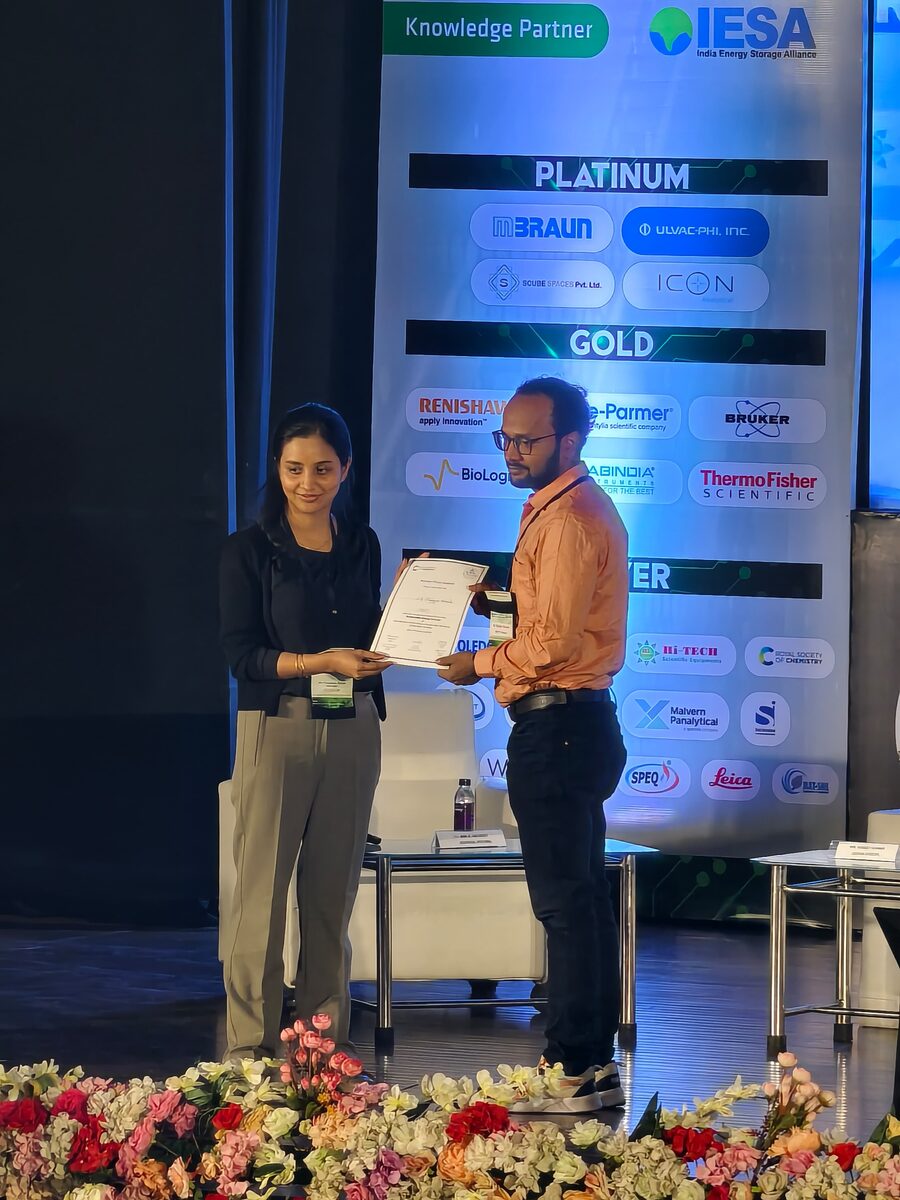
Recipient of the MHRD doctoral fellowship (2016) and teaching
assistant award for the Winter School on Electronic Structure
and Molecular Dynamics Simulations (2020). Certified in Quantum
Computing jointly by C-DAC and IIT Roorkee (2025).